

One afternoon in October, I ran the same hospital website through three AI visibility tools. The first gave it 82 out of 100 and called it "Strong". The second gave it 26 and said it was "Largely absent from AI answers". The third didn't give a score at all. It counted 25.9K AI responses. So what is an AI visibility score? It's an estimate of how often AI tools like ChatGPT and Google's AI Overviews mention or cite your brand across a sample of questions. The catch is that every tool picks a different sample.
That's the short answer. Here's what each of those three numbers actually measured, why AI visibility became worth tracking this year, and the four things I now check before I trust any score.
Key takeaways
An AI visibility score estimates how often AI answers mention or cite your brand across a set of prompts. No AI engine publishes an official one.
Tools sold as "AI visibility" measure three different things: readiness (can AI read your site), presence (do answers name you) and footprint (how many answers cite you).
AI answers change with almost every run. Track how often you appear across many prompts and runs, not your position in a single answer.
Use the PACE check: Presence, Accuracy, Citations and Effect. A high score means little if the answer is wrong or nothing reaches your business.
Google Search Console now reports your impressions in AI Overviews and AI Mode. Read it next to any tool score, because it's the only first-party view you get.
What is an AI visibility tool, in plain language?
An AI visibility tool checks whether AI assistants mention your brand when people ask questions about your category. That means ChatGPT, Gemini, Perplexity, Microsoft Copilot, Claude, and Google's AI Overviews and AI Mode.
Most of them work the same way:
The tool sends a list of questions (prompts) to each AI engine, such as "best hospital for cardiology in Abu Dhabi".
It reads every answer that comes back.
It records whether your brand was named, where it appeared, and which web pages were cited as sources.
It rolls all of that into one number, usually out of 100. That's your AI visibility score.
Think of it as the AI-era cousin of a rank tracker. A rank tracker tells you where you sit in Google's blue links. An AI visibility tool tells you whether you made it into the answer at all.
The score is only as good as the questions behind it.
Three tools, one hospital, three different answers
Back to that afternoon. The site belongs to a multi-specialty hospital in the UAE that I work with, so I'll keep it anonymous. I ran it through two free checkers and Ahrefs on the same day.
Tool
What it said
What it actually measured
Tool
Arobis free checker
What it said
82/100, "Strong". ChatGPT 81, Gemini 92, Claude 82, Perplexity 90
What it actually measured
Readiness. Its own note says the scores come from the site's signals, not live questions to each AI model
Tool
Omnibound AI free audit
What it said
AI visibility 26/100, "Largely absent". Mention rate 39, recommendation rate 17, across 23 prompts on 4 engines
What it actually measured
Presence, from a small prompt sample. It scored "AEO readiness" separately, at 72
Tool
Ahrefs Site Explorer
What it said
25.9K AI responses citing the site, across 1.6K pages
What it actually measured
Footprint: how many responses in Ahrefs' own prompt index link to the site
Source: author's checks, October 2026. Hospital anonymised.
So which one was right? In a way, all three. They just answered different questions.
Arobis asked: can AI engines read this site? The answer was yes. But its "Gemini 92" had nothing to do with what Gemini actually says about the hospital.
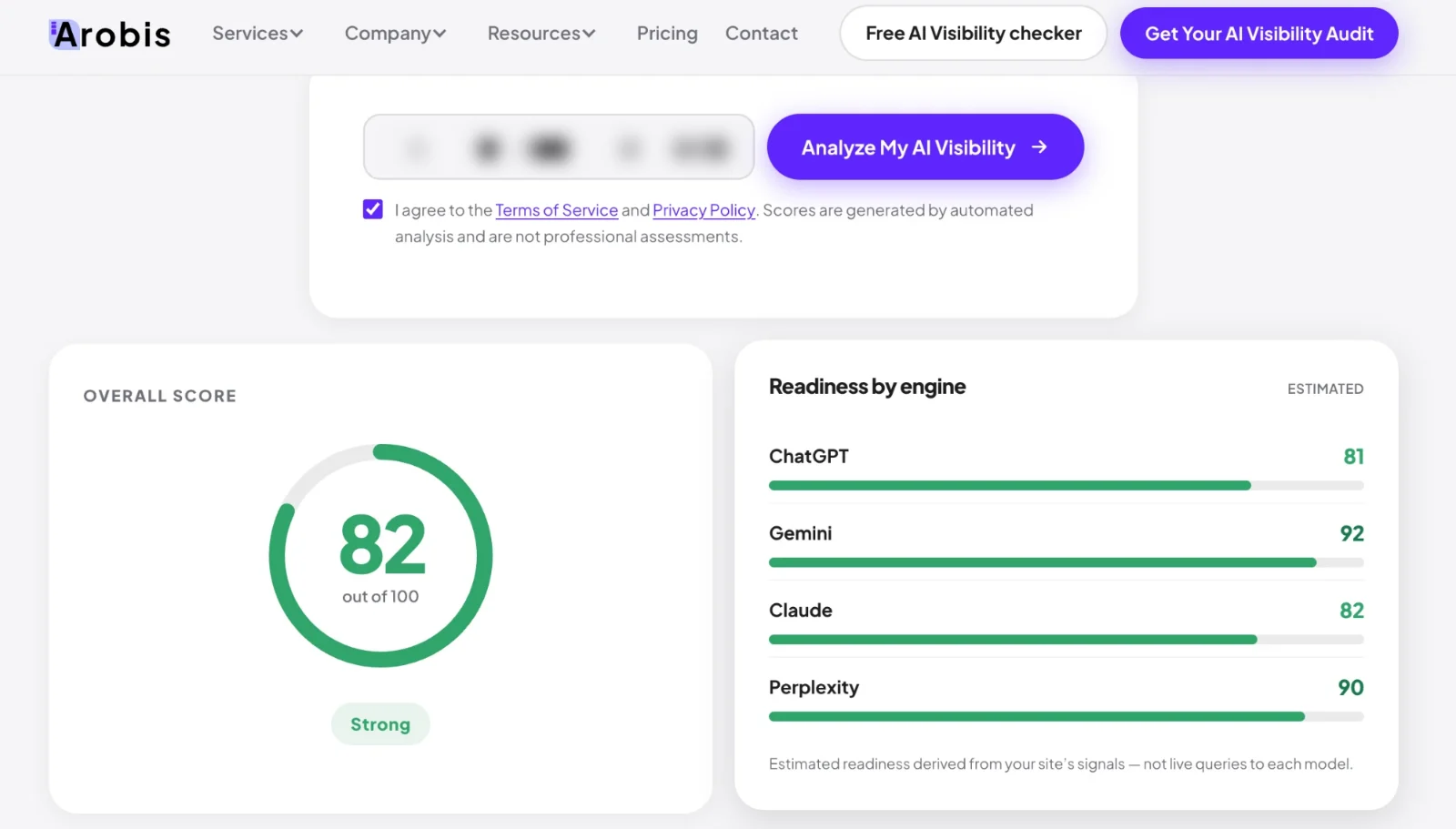
Arobis free checker: 82/100, scored from site signals rather than live AI answers.
Omnibound asked: when buyers ask questions, does AI name this hospital? Across 23 prompts, the hospital was mentioned in 39 percent of answers and recommended in 17 percent. One detail worried me. The tool had filed the hospital as a "healthcare and pharmaceutical company". If the category is wrong, the prompts are wrong, and so is the score.
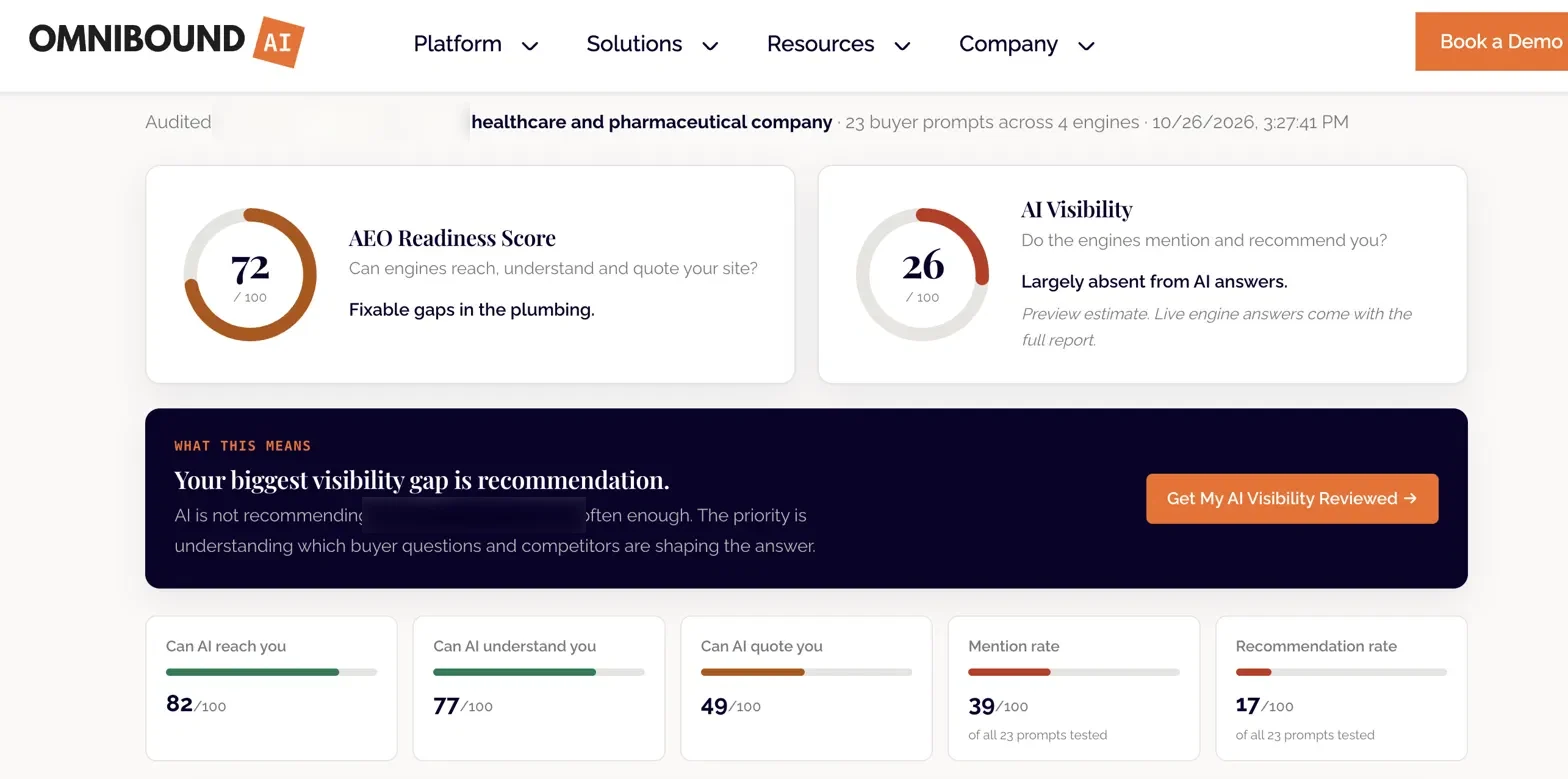
Omnibound AI free audit: 26/100 visibility from 23 prompts across 4 engines.
Ahrefs asked: across millions of tracked prompts, how often is this site linked? It doesn't give a score out of 100. And of those 25.9K responses, 21.2K came from Google's AI Overviews and 3.8K from AI Mode. ChatGPT accounted for 467. Google's two AI features made up about 96 percent of the total.
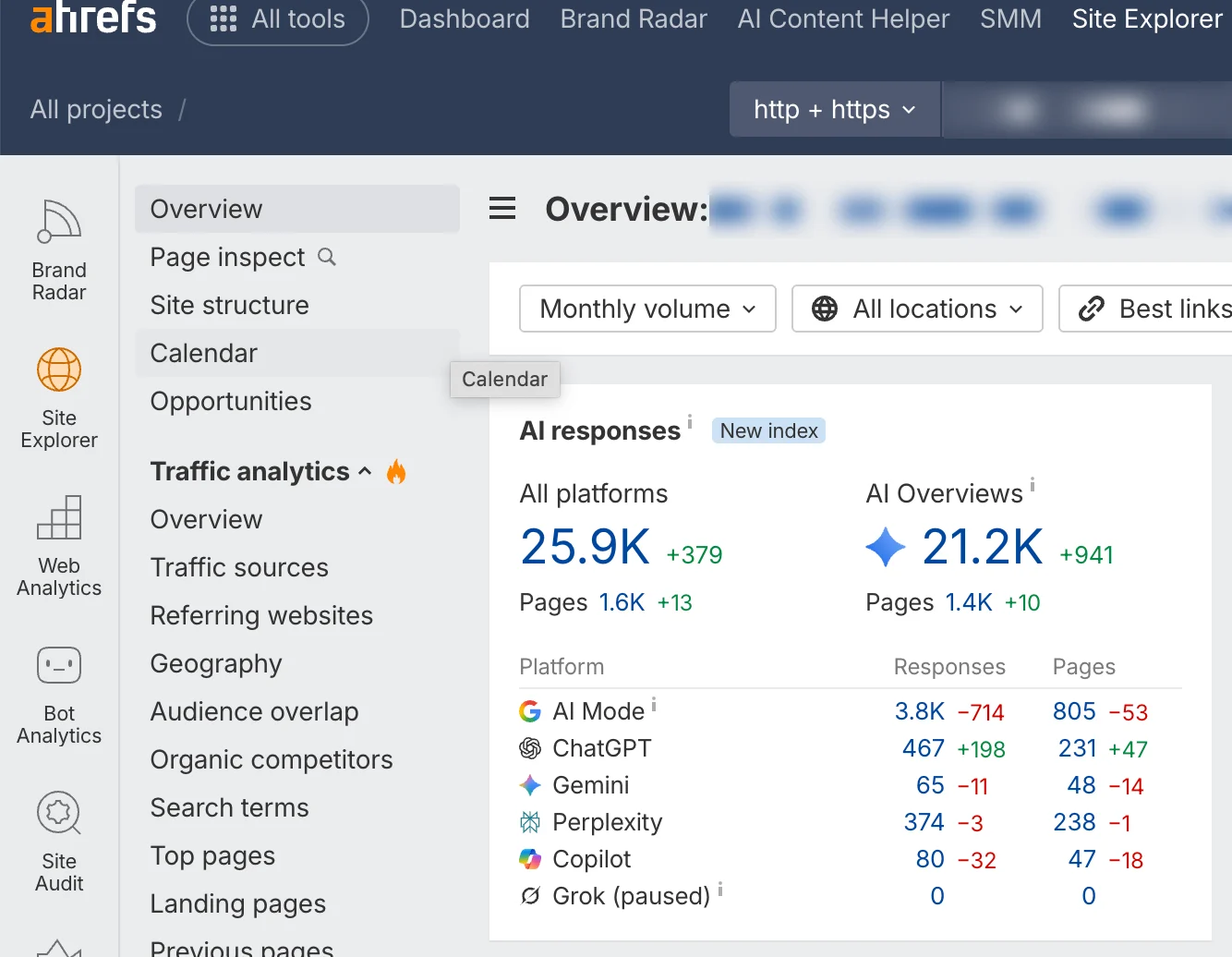
Ahrefs Site Explorer: 25.9K AI responses, most of them from Google’s AI Overviews.
That last detail changed how I read the whole thing. Part of it reflects the hospital's real audience, and part reflects Ahrefs' own index, which tracks far more Google searches than ChatGPT prompts. Either way, for this hospital, "AI visibility" in that tool is mostly Google visibility.
Before you trust a score, find out which question it answered: can AI read you, does AI mention you, or does AI cite you?
Why AI visibility became worth measuring in 2026
People have talked about AI search for two years. Three things made it a real metric this year.
Google started reporting it. On 3 June 2026, Google launched Search Generative AI performance reports in Search Console. By August they had reached every property. For the first time, you can see impressions in AI Overviews and AI Mode separately from blue-link results.
The answer is now the shelf. When someone asks AI for the best hospital or the best clinic, the shortlist forms inside the answer. If you're not in it, you don't get considered, even if you rank on page one.
Clients ask for it. On my accounts, an AI visibility number now sits in the monthly report next to rankings and traffic.
There's a fair counter-argument. Most discovery still happens in classic search, and AI assistants are still a smaller share of it. I agree. That's exactly why AI visibility belongs next to your SEO reporting, not instead of it.
Why does your AI visibility score change every time you check?
Because AI answers aren't fixed. Ask the same question twice and you can get two different lists.
The clearest evidence comes from SparkToro and Gumshoe.ai. Volunteers ran 12 recommendation prompts 60 to 100 times each, 2,961 runs in total, published in early 2026. ChatGPT and Google's AI returned the same list of brands less than 1 time in 100. The same list in the same order came up less than 1 time in 1,000.
But there was a pattern underneath. Brands that are genuinely strong in a category kept showing up in a large share of answers, however the question was worded.
So two things follow:
Position is mostly noise. "We're number two in ChatGPT" is true for one run, on one day.
Frequency is the signal. How often you appear across many prompts and many runs is the number worth trending.
That's why most tools report a mention rate. Here's the working, with illustrative numbers:
Mention rate = answers that name you ÷ answers checked × 100
50 prompts × 4 engines × 3 runs = 600 answers
Your brand is named in 150 of them
Mention rate = 150 ÷ 600 × 100 = 25%
Illustrative example, not client data.
Some tools then weight it by position, so an early mention counts for more than a late one. That's useful, as long as you know the tool is doing it.
Scores also move for reasons that have nothing to do with your brand: a different prompt set, a model update, a different country or language, or the user's chat memory.
A score from 23 prompts is a snapshot. A score from hundreds of prompts, run again and again, is a trend.
What really matters to measure: the PACE check
One number can't tell you whether AI is helping or hurting your brand. So I now look at four things, in this order.
Framework
The PACE check
Presence. How often are you mentioned across a fixed set of prompts that you chose? Track the mention rate per engine and per topic, for example treatments, symptoms, "best hospital for" and doctor names.
Accuracy. When AI talks about you, is it right? Check specialities, locations, doctor names and opening hours. In healthcare, a wrong answer can be worse than no answer.
Citations. Which sources does AI use when it describes you: your own pages, or directories, news sites and competitors? This tells you what to fix, and where.
Effect. Does anything reach the business? Look at AI impressions in Search Console, AI referrals in Google Analytics 4 (GA4), and your branded search trend.
Presence is the score most tools sell. The other three are where the decisions come from.
Accuracy is the one I'd never skip. If AI gets your basic facts wrong, clear structured data on your own site is one of the first fixes. I explain how in Schema is your website's resume.
What the dashboard shows
What I'd look at instead
One score out of 100
Mention rate, split by engine and by topic
"We rank number two in ChatGPT"
Share of answers you appear in, over many runs
A readiness score per engine
A technical checklist, not a visibility metric
Total AI responses
Which pages are cited, and for which topics
"The score went up"
Whether AI impressions, AI referrals or branded searches moved too
A readiness score tells you the door is open. It doesn't tell you anyone walked through it.
How to read Search Console's AI report next to your score
Google's generative AI report in Search Console is the only first-party AI visibility data you'll get, so use it as your anchor.
It shows your impressions in AI Overviews and AI Mode, with a separate view for Discover. You can break it down by pages, countries, devices and dates, with data starting from 18 May 2026. It doesn't show the queries behind those impressions or the clicks they produced. The report also won't appear until your site has enough AI impressions.
Here's how I use it alongside a tool score:
Export the pages with AI impressions. Compare them with the pages your tool says are cited. Where both agree, you can trust the picture.
Filter by country. Many tools run their prompts for a single market. If your patients or customers are in the UAE, look at UAE impressions.
Watch the trend after a change. Publish or fix a page, then look at its AI impressions over four to eight weeks, not day by day.
Label it honestly. Impressions aren't clicks, and they aren't revenue. Say so in the report.
It only covers Google. For ChatGPT, Perplexity and Copilot you still need a tool, plus the AI referral traffic you can see in GA4.
If Google's AI features matter most to you, as they did for the hospital above, my notes on how to rank in AI Overviews are the next read.
Where AI visibility scores break
I still use these tools. But I want to be clear about what they can't do.
There's no standard. Every vendor uses its own prompts, engines and formula. You can't compare a score from one tool with a score from another, and published "good score" bands are guesses.
The prompts may not be your customers' prompts. Check the language, the market and the category the tool assumed. One of mine filed a hospital as a pharmaceutical company.
Small samples swing. A score built on 20 or 30 prompts can jump without anything changing on your site.
Readiness isn't visibility. A site that AI can read easily can still be left out of the answers.
A score isn't an outcome. None of these numbers tells you whether a patient booked or a customer bought.
So when a CMO asks for "our AI visibility score", I give them three things instead: the mention rate trend from one tool with a fixed prompt set, the Search Console AI impressions trend, and any accuracy problem we found.
Bonus Tip: write your own 20 prompts
Before you pay for any tool, write 20 questions your customers actually ask, in their words and their languages. For the UAE, that often means English and Arabic. Run each one in ChatGPT, Gemini and Perplexity while logged out, three times, and note who gets named. It takes an afternoon, and it gives you a baseline to judge any vendor's score against.
What to do on Monday
Run your brand through two tools and write down what each one actually measures.
Open the generative AI report in Search Console and export the pages with AI impressions.
Pick 20 to 50 prompts by topic, and keep them fixed for a quarter.
Read five AI answers about your brand and note any factual errors.
Add AI referrals (chatgpt.com, perplexity.ai, gemini.google.com, copilot.microsoft.com) as their own channel group in GA4.
Frequently asked questions
01
What is a good AI visibility score?
What is a good AI visibility score?
There's no universal benchmark, because every tool uses its own prompts, engines and formula. A good score is one that's rising against your own baseline, and against competitors measured in the same tool with the same prompts. Comparing your score in one tool with a number from another tool tells you very little.
02
Can I check my AI visibility for free?
Can I check my AI visibility for free?
Yes. Free checkers give you a quick snapshot, and Google Search Console's generative AI report shows your impressions in AI Overviews and AI Mode at no cost. You can also run your own prompts by hand. Read the small print on free checkers, because many measure readiness or use very small prompt samples.
03
Is AI visibility the same as GEO?
Is AI visibility the same as GEO?
Not quite. Generative engine optimisation (GEO) is the work you do to get mentioned and cited in AI answers: content, structured data, reputation and technical access. AI visibility is how you measure whether that work is paying off. One is the activity, and the other is the scoreboard.
04
How often should I track AI visibility?
How often should I track AI visibility?
Weekly or monthly is enough for most brands, as long as the prompt set stays the same. AI answers vary from run to run, so daily checks mostly show noise. Look at the trend over a month or a quarter, and check again after a major content change or a model update.
05
Does ranking on Google improve AI visibility?
Does ranking on Google improve AI visibility?
Often, especially for Google's AI Overviews and AI Mode, which draw on Google's own index. For the hospital in this post, about 96 percent of the AI responses Ahrefs found came from those two features. But ranking isn't a guarantee, and ChatGPT or Perplexity may cite different sources.
Has your AI visibility score ever told you something you could act on? Or did it just give you a number for the report?
If you try the PACE check, or if it doesn't work the way I described, write to me. I'd genuinely love to hear how it goes.