


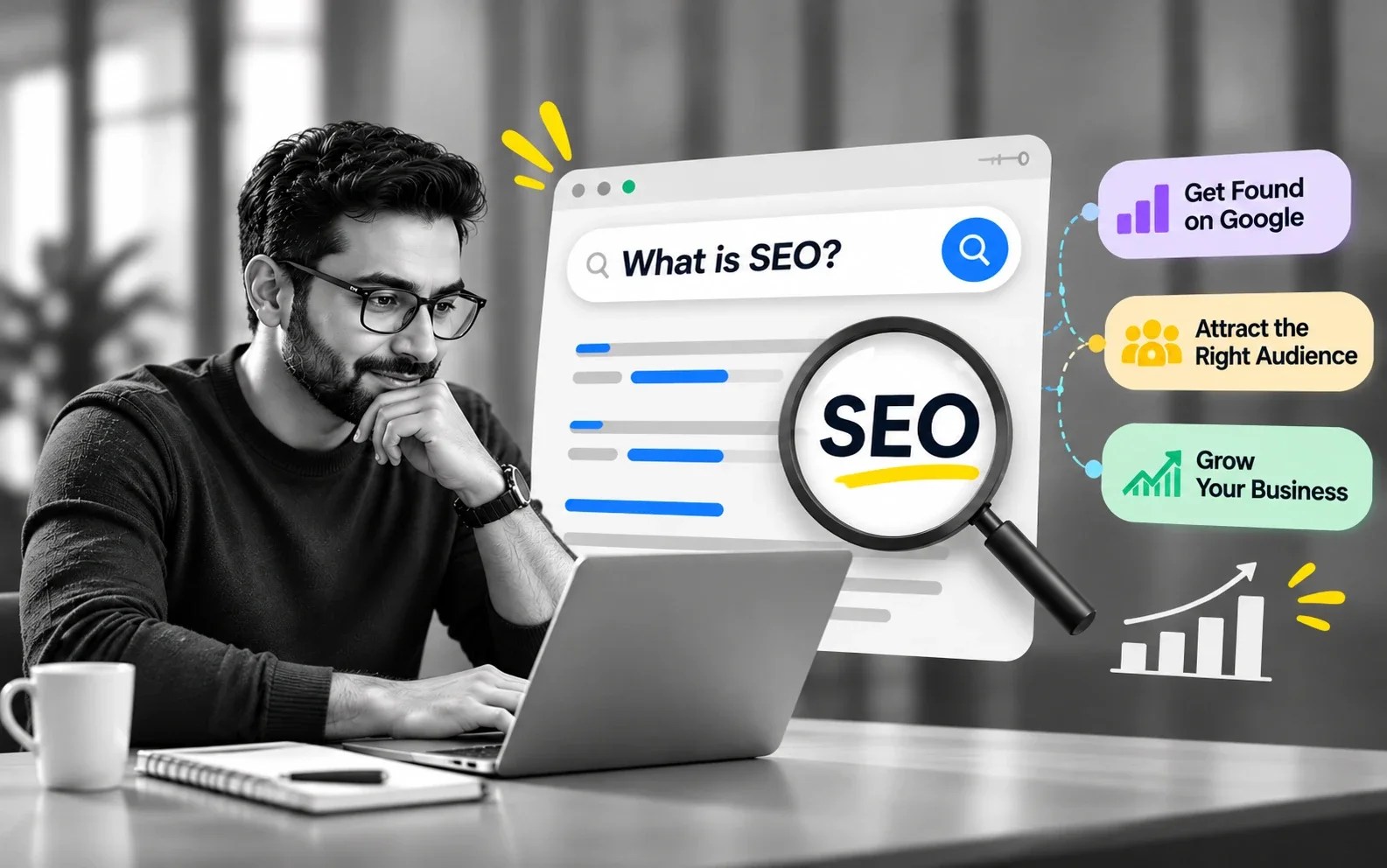
A healthcare client once asked me, "Why am I not on Google?" So we searched together, using the words a patient would type. Their site wasn't using those words. That is SEO in one small moment. SEO, or search engine optimisation, is the work of helping search engines find and understand your website, and helping people choose it, so you appear in search results without paying for each click.
That's the short answer. Here's what that search taught us, how SEO actually works, and what you can do about it this week.
Key takeaways
SEO stands for search engine optimisation. It helps your website appear in unpaid search results when people look for what you offer.
Search engines work in three stages: they crawl pages, store them in an index, and rank the best matches for each search.
Every website has to pass four questions: can search engines find you, understand you and trust you, and will people choose you?
Paid ads buy visibility straight away and stop when you stop paying. SEO builds more slowly, and the work keeps paying back.
What is SEO, in plain language?
SEO is the work of making your website easier to find in search engines, without paying for the placement. Those unpaid listings are called organic results.
Picture a receptionist in a huge building. To send you to the right office, the receptionist has to know the office exists, know what it does and believe it's any good. Then you still have to like the look of it when you arrive. A search engine is that receptionist, working at enormous scale.
That brings me back to my client. Their site described its services in the organisation's own language. Patients searched in theirs. When we typed a patient's search into Google together and looked at who appeared, the problem was right there on the screen. So we rewrote the pages using the words patients actually use, and their visibility improved.
Write the way your customers search, not the way your organisation talks.
How do search engines work?
Search engines work in three stages: crawling, indexing and ranking. Ahrefs and Semrush both explain it this way.
Crawling. Automated programs called crawlers follow links across the web to discover pages.
Indexing. The search engine stores what it learned about those pages in a huge database called the index. Not every page gets in.
Ranking. When someone searches, the search engine's algorithms choose and order the results from the index.
Nobody outside Google knows the full ranking formula. Google's SEO Starter Guide says so itself: "There are no secrets here that'll automatically rank your site first in Google (sorry!)."
Be careful with anyone who guarantees you the number one spot.
The four questions every website has to pass
SEO gets simpler when you treat it as four questions, asked in order. I call this the Four-Question Test.
Framework
The Four-Question Test
Find: Can search engines reach your pages?
Understand: Can they tell what each page is about and who it's for?
Trust: Do other credible sources vouch for you?
Choose: When your page appears, will a real person pick it?
You'll often hear about three types of SEO: technical, on-page and off-page. They fit the same test, as this made-up ear, nose and throat (ENT) clinic in Dubai shows.
Question
Type of SEO
What you do
Example: a made-up ENT clinic
Question
Find
Type of SEO
Technical SEO
What you do
Link to your important pages and don't block them.
Example: a made-up ENT clinic
The ENT page is linked from the main menu, so crawlers can reach it.
Question
Understand
Type of SEO
On-page SEO
What you do
Use your customers' words in clear titles, headings and body text.
Example: a made-up ENT clinic
The page uses the everyday words patients type, as well as the medical terms.
Question
Trust
Type of SEO
Off-page SEO
What you do
Earn backlinks, which are links from other websites to yours, plus mentions and reviews.
Example: a made-up ENT clinic
A respected local publication links to the clinic's guide for patients.
Question
Choose
Type of SEO
On-page SEO
What you do
Write a title and description that match what the searcher wants.
Example: a made-up ENT clinic
The search result names the service and the area, so a patient knows it's relevant.
Source: author's framework. The clinic is illustrative and not a real business.
If you only have time for one, start with Understand. Google says useful, compelling content will likely influence your presence in search more than anything else in its guide. It's also where my client's problem was.
A page has to be found before it can be trusted, and trusted before it can be chosen.
To go further on helping machines understand you, read my post on schema markup.
What is the difference between SEO and paid ads?
SEO earns your place in the unpaid results. Paid ads buy a place, and you're usually charged each time someone clicks.
SEO
Paid ads
No charge per click, but the work costs time or money
You pay for each click, on top of creating the ads
Usually takes weeks to months
Can start almost immediately
Can keep working after the work is done, with upkeep
Stops when you stop paying
Suits long-term growth and research-stage questions
Suits launches, promotions and testing offers
Source: Semrush, What is SEO?, July 2026, reworded by the author.
So is SEO free? Ahrefs calls SEO traffic free. Search Engine Land says it isn't, because the work takes time and money. I think both are right. The click is free. Earning the click isn't.
I work across paid media and SEO, so I don't need one to win. If you need enquiries this month, ads will get you there sooner. If you want to be found in two years' time, start SEO now.
Ads rent you attention. SEO builds something you keep, as long as you look after it.
What is SEO in digital marketing?
In digital marketing, SEO is the channel that reaches people who are already looking for what you offer. Paid ads, social media and email reach the people you choose. Search engine optimisation catches people at the moment they search.
It works best alongside the other channels. Content gives SEO something to rank. Ads show you quickly which words bring enquiries, so you know which pages to build first.
That's how I plan it. When I built a doctor's digital marketing plan, SEO was one part of the path to a booked appointment, next to the booking page, paid media and reviews. It wasn't a separate project.
How long does SEO take?
Expect to wait a few weeks before judging a change, and often three to six months before seeing meaningful results.
Google says some changes take effect within hours and others take several months. It suggests waiting a few weeks to assess your work. Ahrefs polls with 3,680 responses put the typical wait at three to six months, and Search Engine Land adds that competitive keywords often take longer.
Treat that as a rough guide, because a poll collects opinions and doesn't measure results.
Does SEO still matter with AI answers?
Yes, SEO still matters, but ranking first no longer guarantees you'll be seen.
Google's AI Overviews put a written summary above the results for some searches, and tools like ChatGPT answer questions directly. Showing up in those answers is often called generative engine optimisation, or GEO.
Semrush (July 2026) found that AI Overviews pulled from Google's top 10 results about 67% of the time. Ahrefs (March 2026) found only 38% of cited pages ranked in the top 10, as I covered in my post on ranking in AI Overviews. Those numbers don't match, and different methods are the likely reason. Both are SEO tool companies, but they agree on the direction: ranking helps, and it isn't the whole story.
I've seen this first-hand. At Reem Hospital in Abu Dhabi, between 2024 and 2025, our pages were cited in AI Overviews next to Cleveland Clinic and government health agencies. We didn't outrank them. We wrote sentences that were easier to quote.
The basics that help you rank are mostly the same basics that help you get quoted.
Where to start this week, and when not to
You can start SEO this week without buying a tool.
Set up Google Search Console. It's free, and it shows which searches you appear for and how often people click.
Write down five searches. Ask your customers what they'd type. Don't guess.
Run those searches yourself. Note who appears and what kind of page Google shows. It's the same search I ran with my client.
Fix one page. Use your customers' words in the title, the headings and the first paragraph.
If you're a doctor, my post on digital marketing for doctors shows how this fits into a full plan.
Bonus Tip: check whether Google has found you
Type site:yourdomain.com into Google, using your own domain. If your pages appear, you're in the index. If nothing appears, look for something blocking Google before you touch your content.
SEO isn't always the right first move, though.
You need enquiries this month. Start with ads and build SEO alongside them.
Nobody searches for what you sell yet. SEO captures existing demand, so you may need to create that demand elsewhere first.
You're chasing a huge term. I don't expect this post to outrank Google's own guide for "what is SEO". A smaller, more specific search is often the better target.
So that's SEO: help search engines find you, understand you and trust you, then give people a reason to choose you.
Frequently asked questions
01
How do I know if my SEO is working?
How do I know if my SEO is working?
Track what your search results lead to, not just your rankings. Google Search Console shows impressions, clicks, click-through rate and average position. Google Analytics 4 shows organic traffic and conversions, such as form submissions or calls. Compare results with an earlier period, and judge success by enquiries and sales, because a high ranking that brings no customers has little value.
02
What is local SEO?
What is local SEO?
Local SEO helps your business appear when people search for something nearby, such as "vet near me". Start with a complete Google Business Profile, then collect genuine reviews and keep your business name, address and phone number identical everywhere online. Listings in relevant local directories also help. It matters most for shops, clinics and other businesses with a physical location.
03
How many words should a page have for SEO?
How many words should a page have for SEO?
There is no ideal number. Google says content length alone doesn't matter for ranking, and that there is no magical minimum or maximum word count. Write as much as the reader needs to get the answer, then stop. A short page that answers the question clearly can do better than a long one stuffed with filler.
04
How much does SEO cost?
How much does SEO cost?
It depends on who does the work. Doing it yourself costs mainly time. An Ahrefs pricing study gives averages of about USD 134 an hour for agencies, USD 122 for consultants and USD 68 for freelancers, plus retainers. Those figures may not match UAE rates, so get local quotes and ask what work is included.
05
What is E-E-A-T, and is it a ranking factor?
What is E-E-A-T, and is it a ranking factor?
E-E-A-T stands for experience, expertise, authoritativeness and trustworthiness. Google's quality raters use it to assess search results, and trust is the most important part. Google says E-E-A-T itself is not a ranking factor, so there is no score to optimise. Treat it as a guide to good content: show who wrote it, cite sources and get the facts right.
What's the one thing about SEO that still doesn't make sense to you?
Write to me and tell me. And if you try these steps, or if they don't work the way I described, I'd genuinely love to hear how it goes.